
Heritage story
The Reading Railroad
The 1833 anthracite hauler that briefly became the largest company in the world — the road behind the Reading Railroad space on the Monopoly board.
One of the four or five most important railroads in American history, largely forgotten outside rail circles.
The question everyone asks
Yes, the "Reading Railroad" on the Monopoly board is a real Pennsylvania railroad. It's pronounced RED-ing, like the city it was named after, and Hasbro's own customer database confirms the pronunciation. The four Monopoly rails came from Atlantic City, where an early homemade version of the game was played in the late 1920s. The Reading served Atlantic City through its Pennsylvania-Reading Seashore Lines subsidiary; Short Line refers to the Shore Fast Line, a real Atlantic City streetcar; the B&O did not actually run to Atlantic City but was, for a time, the Reading's corporate parent. Parker Brothers began selling the game on November 5, 1935. For most Americans that little black locomotive is the only "brand" the Reading Company still has. But behind it sits a real railroad chartered in 1833, one that was briefly the largest company in the world.

Charter & Anthracite
1833–1870sThe Philadelphia and Reading Rail Road was chartered by the Pennsylvania legislature on April 4, 1833. The plan was narrow and specific: build a double-track line along the Schuylkill River from Philadelphia up to Reading, then on to the anthracite country at Pottsville, and haul coal for a growing city. The mainline reached Pottsville in 1842; the Port Richmond tidewater terminal in Philadelphia opened May 17 of the same year, giving the road an export dock on the Delaware. By 1844 the railroad had moved 42,843 tons of coal and passed the parallel Schuylkill Canal. Franklin B. Gowen, a former Schuylkill County district attorney, took the presidency in 1869 and pushed the road into vertical integration. In 1870 the Reading bought the canal it had beaten. In 1871 it organized the Philadelphia & Reading Coal & Iron Company and started acquiring mines, eventually controlling more than 40% of United States anthracite reserves and roughly 142 square miles of coal land.
Empire, Terminals & the Molly Maguires
1871–1920sBy 1871 the railroad was, on paper, the largest company in the world: a $170 million market capitalization that Wikipedia's Reading Company article calls the equivalent of roughly $4.5 billion today. Gowen's other bet was harder. In 1873 he hired the Pinkerton Detective Agency and put an operative inside the Molly Maguires, a secret society of Irish miners. Twenty men were hanged between 1876 and 1878, ten of them on a single day, June 21, 1877, known as Black Thursday, with Gowen himself acting as special prosecutor. Historian Harold Aurand later called the sequence one of the most astounding surrenders of sovereignty in American history: a private corporation investigating, a private police force arresting, and company attorneys prosecuting. On January 29, 1893, the Reading opened its Center City terminal at 12th and Market in Philadelphia. Francis H. Kimball designed the nine-story headhouse; Wilson Brothers & Company designed the single-span arched train shed, then among the largest in the world and today the only one of its kind still standing in the United States. In 1896 the road was reorganized as the Reading Company, a holding structure over the railway and the coal company. Antitrust action forced the mining subsidiary out in 1923; the following year the Philadelphia & Reading Railway stopped operating trains and the Reading Company took over directly.

The T-1s and the Iron Horse Rambles
1930s–1960sThe Reading built most of its steam power in its own Reading shops. The T-1 class of 4-8-4 Northerns is the road's signature: thirty locomotives rebuilt between 1945 and 1947 from earlier I-10sa 2-8-0 Consolidations, with Baldwin Locomotive Works supplying parts. The last ten T-1s were completed in 1948 and are widely counted as the last steam locomotives built for any American railroad. Ten years later the road turned that fleet loose on paying fans. The Iron Horse Rambles ran from 1959 to 1964, using T-1s 2100, 2102, and 2124 with 2101 in reserve. The first Ramble left Wayne Junction in Philadelphia on October 25, 1959, behind No. 2124, running to Shamokin with 950 passengers on board. Fifty-one trips followed over five seasons; Gettysburg was the most repeated destination. The last Ramble ran Philadelphia to Tamaqua on October 17, 1964. By then the road's freight was already being eaten by trucks and the 1956 Interstate Highway Act, and the Reading was on the slow slide toward receivership.
Bankruptcy & Conrail
1971–1976The Reading filed for bankruptcy on November 23, 1971, a knock-on effect of the Penn Central collapse the year before, on top of collapsing coal traffic and highway competition. SEPTA absorbed most of the remaining passenger service by 1974. On April 1, 1976, the railroad's operating assets were folded into the newly formed Consolidated Rail Corporation, better known as Conrail. What was left of the Reading Company held on to roughly 650 real-estate parcels, some coal properties, and 52 abandoned rights-of-way. The corporation was later renamed Reading International; through a three-way merger finalized December 31, 2001 it continues to exist on the NASDAQ as RDI, now in the movie-theater and real-estate business, with no track, no locomotives, and no relation to the Reading & Northern that operates today.
What Survives
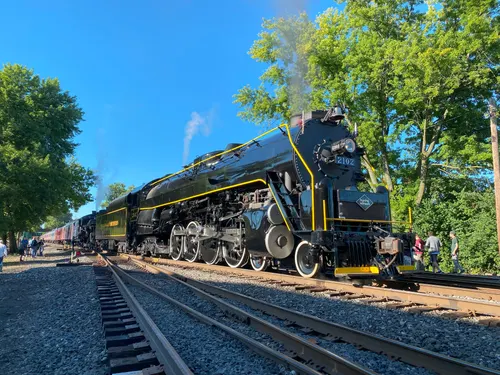
1976–todayHalf a century after the Reading stopped running its own trains, the road is still findable on the ground. In Philadelphia, the 1893 train shed is now the Grand Hall of the Pennsylvania Convention Center; stainless-steel rails are set into the terrazzo floor to mark where the tracks ran, and Reading Terminal Market continues underneath. In Reading itself, Franklin Street Station has been a passenger depot, a bus terminal, an art installation, and since July 2019 the Saucony Creek Franklin Station Brewpub. Up in Berks County, the Reading Railroad Heritage Museum opened at 500 South Third Street in Hamburg on April 12, 2008, under the Reading Company Technical & Historical Society, which was incorporated in July 1976. The museum holds more than 70 pieces of rolling stock, including the first production General Motors GP-30 diesel-electric locomotive, No. 5513. Andy Muller Jr.'s Reading & Northern, founded in 1983, runs freight and excursions across more than 400 miles of former Reading and Central Railroad of New Jersey track from its Port Clinton shops. T-1 No. 2102 came back to life on May 28, 2022, hauling a nineteen-car Iron Horse Ramble from Reading to Jim Thorpe. Two other T-1s survive as static displays: No. 2101 at the B&O Railroad Museum in Baltimore, and No. 2124 at Steamtown in Scranton. No. 2100 is under restoration in Cleveland, planned to run as Reading 250 for the United States semiquincentennial in 2026.
Full timeline
Philadelphia and Reading Rail Road chartered by the Pennsylvania legislature on April 4.
Main line opens to Pottsville; the Port Richmond tidewater terminal opens in Philadelphia on May 17.
Railroad moves 42,843 tons of anthracite and surpasses the parallel Schuylkill Canal.
Franklin B. Gowen becomes president of the Philadelphia & Reading.
The Reading buys the Schuylkill Canal, its former competitor.
The Philadelphia & Reading Coal & Iron Company is organized; market capitalization is reported at $170 million, briefly making it the largest company in the world.
Gowen hires the Pinkerton Detective Agency; operative James McParlan is planted inside the Molly Maguires.
Molly Maguires trials begin; twenty men are convicted and hanged over 1876–1878 with Gowen serving as special prosecutor.
"Black Thursday" on June 21: ten men are hanged in a single day. In July, rioters burn the Reading's Lebanon Valley bridge during the Great Railroad Strike.
Franklin B. Gowen dies on December 13.
Reading Terminal opens at 12th and Market in Philadelphia on January 29 with a Kimball-designed headhouse and Wilson Brothers arched train shed.
Reading Company is reorganized as a holding company over the railway and the coal company.
Antitrust action forces divestiture of the Philadelphia & Reading Coal & Iron Company.
Philadelphia & Reading Railway ceases operating; the Reading Company begins direct operation.
Parker Brothers begins selling Monopoly on November 5. Reading Railroad is one of the four rails on the board.
The Crusader stainless-steel streamliner enters service between Philadelphia and Jersey City.
The Reading shops begin rebuilding I-10sa 2-8-0 Consolidations into T-1 class 4-8-4 Northerns.
The last ten T-1s are completed. They are widely counted as the last steam locomotives built for any American railroad.
First Iron Horse Ramble departs Wayne Junction on October 25 behind T-1 No. 2124, running to Shamokin with 950 passengers.
The last Iron Horse Ramble runs Philadelphia to Tamaqua on October 17.
The Reading Company files for bankruptcy on November 23.
Rail assets are sold to Conrail on April 1; the Reading Company Technical & Historical Society is incorporated on July 16.
The 1874 Reading Outer Station in Reading burns to the ground on February 20.
Reading Terminal closes to trains on November 6 when SEPTA's Center City Commuter Connection opens.
RCT&HS buys the future museum site at 500 South Third Street, Hamburg, for $120,000.
The Reading Railroad Heritage Museum holds its grand opening in Hamburg on April 12.
The Colebrookdale Railroad reopens the Boyertown–Pottstown branch as a heritage tourist line in October.
T-1 No. 2102 debuts on the Reading & Northern on May 28, hauling a nineteen-car Iron Horse Ramble from Reading to Jim Thorpe.
T-1 No. 2100 passes an FRA-observed steam test on February 26–27 in Cleveland; planned to run as "Reading 250" for the US semiquincentennial.
Where the story survives
- Reading Railroad Heritage Museumartifact
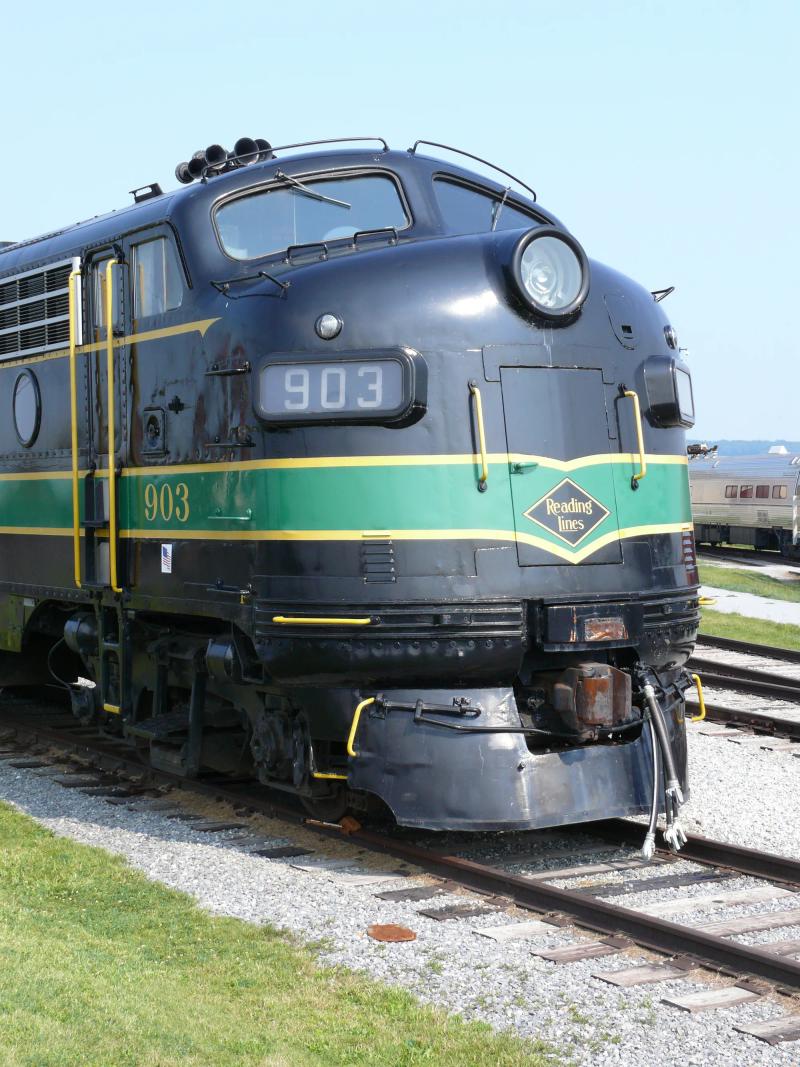
The Reading Company Technical & Historical Society, incorporated July 16, 1976, bought this former Pennsylvania Steel Company site in 2003 and opened the museum on April 12, 2008. The yard at 500 South Third Street, Hamburg holds over 70 pieces of Reading rolling stock, including GP-30 No. 5513 — the first one General Motors built.
Visit → - Franklin Street Stationstation
The Reading opened this depot at 100 South Seventh Street in February 1930 with 3,000 people at the ceremony; the last passenger train left in 1981. After stretches as a bus terminal and an art installation, Saucony Creek opened its brewpub inside the restored station in July 2019 — original terrazzo floors and marble ticket counters intact.
In the Berks guide → - Reading Outer Station sitedepot-ruin
The 1874 depot burned to the ground on February 20, 1978, and the site now belongs to Reading's Department of Public Works. A single pillar of the Swinging Bridge footbridge, razed by Conrail in 1983, stands in Berks County's Heritage Park as part of the Workers' Memorial. Reading & Northern's modern Outer Station excursion stop, built in 2016 on Route 61, carries the name on.
Railfan spot in the Berks guide → - Reading Terminal & Reading Terminal Marketterminal
Opened January 29, 1893 at 12th and Market in Philadelphia; the Wilson Brothers train shed is the last single-span arched train shed in the country. The final train left November 6, 1984 when SEPTA's Center City tunnel opened, and the 1993–97 conversion made the shed the Grand Hall of the Pennsylvania Convention Center — stainless-steel rails are set into the terrazzo where the tracks ran. The market underneath never closed.
Reading Terminal Market → - Reading & Northern Port Clinton shopsyard
Andy Muller Jr.'s Reading & Northern, founded 1983, runs freight and excursions on over 400 miles of former Reading and Central Railroad of New Jersey track from these shops. T-1 No. 2102 returned to steam here after a six-year, $2.4 million overhaul — Muller lit the firebox on April 4, 2022, and the engine debuted that May 28 on a nineteen-car Iron Horse Ramble to Jim Thorpe.
Reading & Northern → - Wanamaker, Kempton & Southern depotoperator
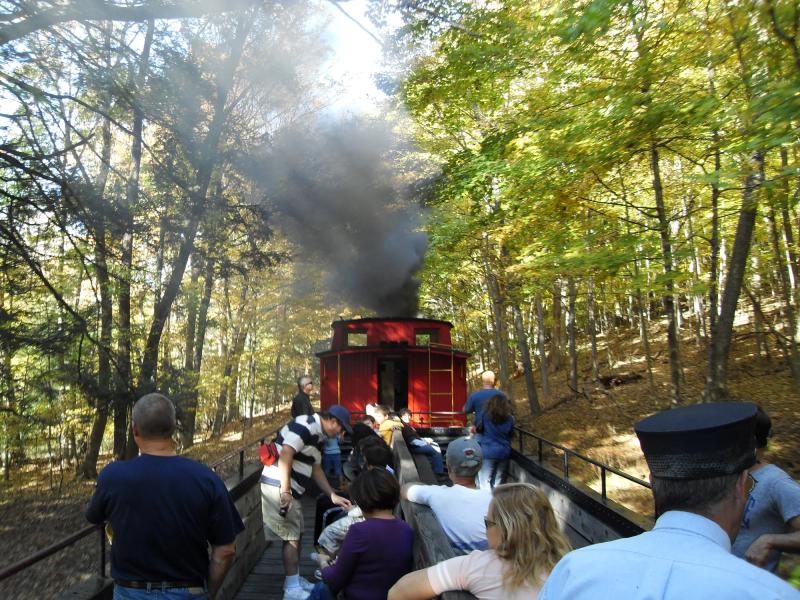
Chartered in 1963 by volunteers who bought three miles of the Reading's Schuylkill & Lehigh branch — the "Hawk Mountain Line" — for $65,000. The Kempton station is assembled from relocated Reading Company buildings, and the 1888 Wanamakers station up the line is still an active excursion stop.
Visit → - Colebrookdale Railroad depotoperator
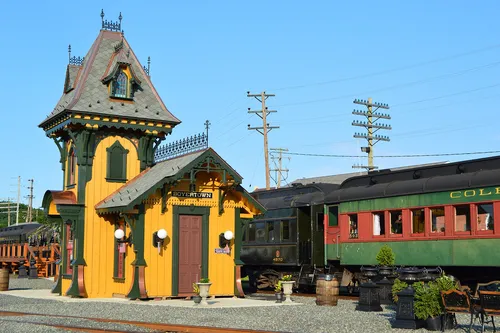
The 1869 iron-ore branch between Boyertown and Pottstown, merged into the Reading in December 1945 and revived as an 8.6-mile heritage line in October 2014. A $40 million Federal Railroad Administration loan approved in 2022 is funding a full rebuild and an extension to Bechtelsville.
Visit → - Wayne Junction Stationstation
The Reading's 1881 commuter hub in Nicetown, Philadelphia, rebuilt in 1901 and still an active SEPTA Regional Rail station in a National Register historic district. The first Iron Horse Ramble left from here on October 25, 1959, with 950 passengers behind T-1 No. 2124.
See it today
Sources & further reading(12)
- Reading Company — Wikipedia
- Reading Terminal — Wikipedia
- Reading Class T-1 — Wikipedia
- Colebrookdale branch — Wikipedia
- Wanamaker, Kempton and Southern Railroad — Wikipedia
- Monopoly (game) — Wikipedia
- Reading Railroad Heritage Museum (official)
- Reading, Blue Mountain & Northern — passenger excursions
- Lehigh Gorge Scenic Railway
- Colebrookdale Railroad (official)
- Wanamaker Kempton & Southern (official)
- Reading Terminal Market (official)
Additional context and local itineraries: Plan a Berks County heritage-rail visit with Experience Berks (Experience Berks).
Sources are linked for review; check dates are shown where available.